
COALITION OF FLORIDA FARMWORKER
ORGANIZATIONS, INC.
COFFO is a nonprofit organization dedicated to improving the living and working conditions of migrant and seasonal farmworkers and the rural poor in Florida. Governed by a nine-member Board of Directors-
one-third representing the Public Sector, one-third the Private Sector, and one-third the Low-Income Sector. COFFO focuses its core services through its offices in Florida City and Immokalee.
While COFFO primarily serves these two communities, it remains prepared to provide statewide support in the event of an agricultural disaster declared by the Governor. COFFO also collaborates with other farmworker organizations to ensure services reach those in need and to minimize duplication of efforts.

OUR MISSION STATEMENT
COFFO was founded in 1980 exclusively for the purpose of bettering the standard of living for agriculture workers and rural poor by administering programs that will assist them in the realization of :
- Economic Upgrading
- Social Justice
- Human Dignity
- Educational and Cultural Advancement
OUR OFFICES
Building A: Conference room
Building B: Main office
Building C: Immigration office
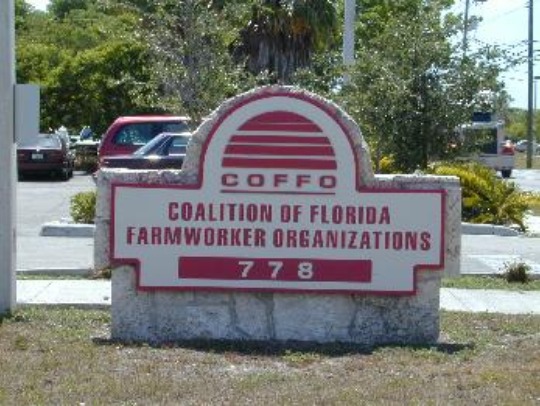

FLORIDA CITY (Main Office)
MULTI-SERVICE CENTER
778 West Palm Drive
Florida City, Florida 33034
(305)246-0357
Fax:(305)246-2445
FLORIDA CITY
IMMIGRATION AND LITERACY
778 West Palm Drive
Florida City, Florida 33034
(305)247-4779
Fax:(305)242-0701
Toll-Free: 1-855-427-6807
IMMOKALEE
MULTI-SERVICE (Satellite) OFFICE
Immokalee, Florida 34143
Mailing address:
P.O. Box 1969
Immokalee, FL 34142
Office address:
1255 N 15th Street, Suite #1
Immokalee, FL 34142
(239)657-7272
Fax: (239) 657-6909
Email: Immokalee@coffo.org
STEVENS AMENDMENT
The Coalition of Florida Farmworker Organizations, Inc., is supported by the U.S. Department of Health and Human Services as part of an award totaling $983,387 (80%); Other federal funds are $80,716 (6%); $56,700 (5%) is financed from local governmental funds, and $109,425 (9%) is from non-governmental sources.